Milling removes material with a rotating cutter to produce pockets, profiles, slots and faces. It is the workhorse of precision manufacturing and the right answer for most prismatic parts - brackets, housings, manifolds, plates and fixtures. Because the cutter approaches from a fixed direction, the geometry of the part and the number of directions it must be reached from decide both the machine and the price.
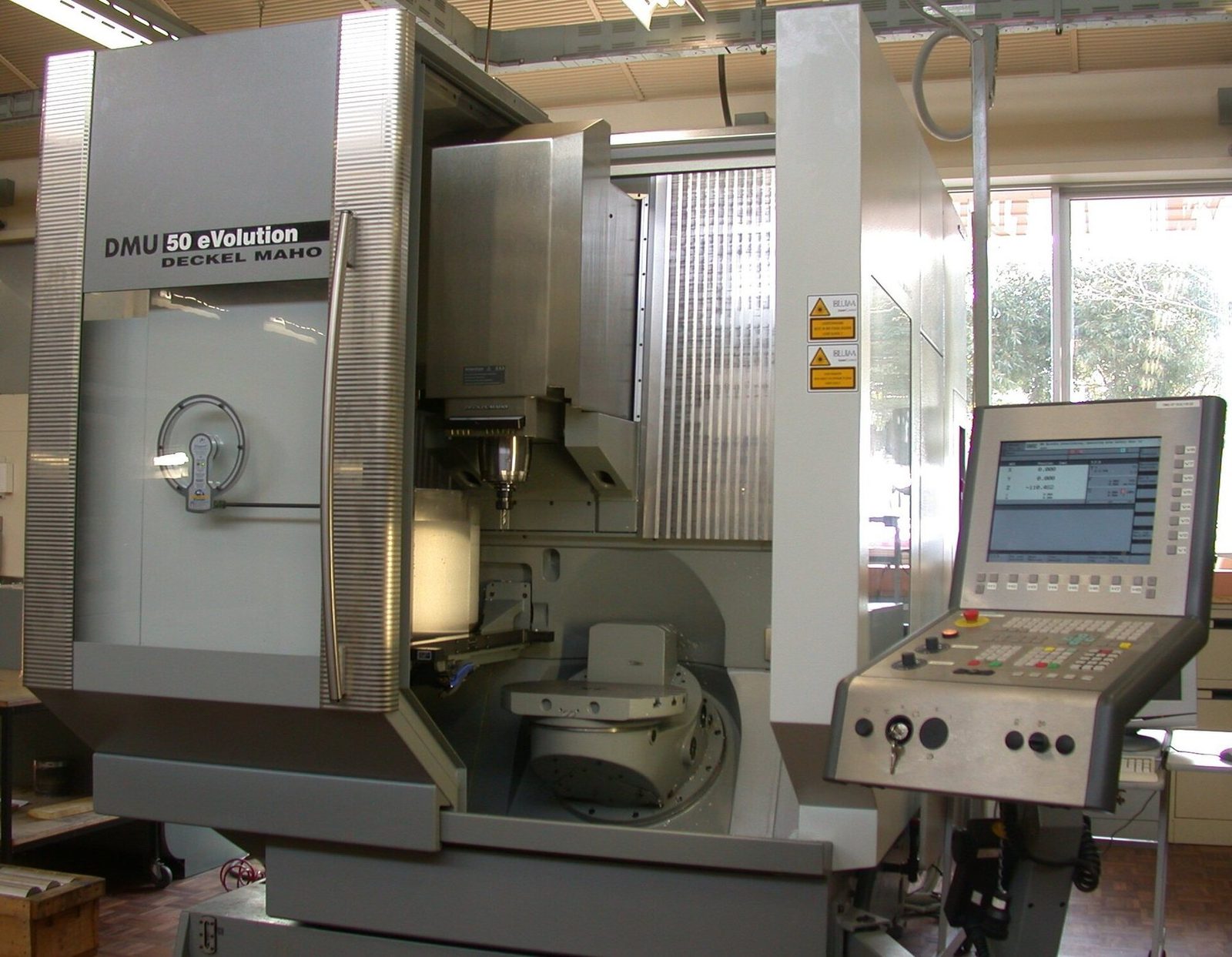
Choosing the right number of axes
3-axis milling machines along X, Y and Z and is the most economical choice for parts that can be reached from a small number of setups. 4-axis adds a rotary table, so several faces can be machined without re-fixturing.
5-axis milling (either indexed or simultaneous) tilts and rotates the tool or table, so undercut features, compound angles and deep pockets can be cut in one setup. Fewer setups means better positional accuracy, because every re-fixture is a chance to lose register.
What drives cost
Cost is mostly setup time plus cutting time. Parts that need many setups, very deep pockets (which demand long, slender tools run slowly), or tolerances tighter than the process can hold reliably all cost more.
Choosing a sensible general tolerance and reserving tight tolerances for the features that genuinely need them is the single biggest lever on price. Material removal volume matters too: a part machined from bar stock removes more material than the same part from a near-net blank.
Design habits that help
Keep pocket depth to about four times the tool diameter where you can, use standard corner radii instead of sharp internal corners (a cutter cannot cut a perfectly sharp internal corner), and put critical tolerances only on critical features.
Thin floors and tall thin walls are the other common problem: they deflect under cutting load and need slower, more expensive passes. Adding a rib or increasing wall thickness is usually cheaper than holding a tight tolerance on a wall that wants to move.
Milling versus turning, and when to switch
If most of the part is round and the milled features are secondary, turning with live tooling usually beats milling. If the part is mostly prismatic with a few turned bores, milling wins.
For features a cutter cannot physically reach - sharp internal corners, very deep narrow slots, hardened material - the answer is usually EDM rather than a smaller cutter, because a very small cutter deflects and breaks before it produces an accurate feature.
| Machine | Best for | Typical planning note |
|---|---|---|
| 3-axis | Prismatic parts, plates, simple housings | most economical |
| 4-axis | Parts needing several faces, round work | fewer setups than 3-axis |
| 5-axis indexed | Compound angles, multi-face parts | one setup, better register |
| 5-axis simultaneous | Complex contours, impellers, undercuts | highest capability, highest cost |
Part families that run well on a mill
- Brackets, mounting plates and structural fittings
- Housings, covers and enclosure components
- Manifolds, fluid blocks and pneumatic bodies
- Fixtures, jigs, soft jaws and tooling plates
- Heatsinks, busbars and electrical mounting plates
What most often goes wrong on a milled part
A cutter leaves its own radius in every internal corner. Calling a sharp corner forces a secondary EDM operation or a smaller, slower tool.
Past roughly four times the tool diameter, the cutter has to be long and slender, which means slow passes, chatter risk and a much higher price.
Applying a single tight tolerance to the whole drawing makes every cosmetic feature as expensive as the functional ones.
Questions we get asked about cnc milling
How tight a tolerance can you hold on a milled part?
Around +/- 0.05 mm is a realistic general tolerance for most materials, and +/- 0.01 mm is achievable on specific critical features with the right setup and inspection. The figure depends on the feature, the material and how rigid the part is, so it is confirmed per part rather than promised as a blanket number.
Is 5-axis always more accurate than 3-axis?
Not by itself. 5-axis wins where it removes setups, because the accuracy gain comes from not re-fixturing the part. If a part can be made in one 3-axis setup, 3-axis is equally accurate and cheaper.
What file formats do you need for a milling quote?
A 3D model - STEP or IGES, or native CAD - plus a drawing with tolerances, datums, material, quantity and finish. The model drives the toolpath; the drawing states which dimensions are actually critical.
Can you machine hardened material?
Above roughly 45-50 HRC, milling becomes slow and tool life drops sharply. Hardened parts are usually better routed to EDM, or machined soft and heat treated afterwards - which is only possible if the heat treatment distortion is accounted for.
- Quote from STEP / IGES / native CAD
- DFM feedback before the first cut
- Inspection report on request
- First article inspection for new parts
Quote a milled part
Send the model, the drawing, the material and the quantity. A manufacturability note comes back with the price, before anything is cut.