EDM removes material with controlled electrical sparks rather than a cutting tool. Because there is no cutting force, it can machine hardened material, produce sharp internal corners and cut features far finer than a milling cutter allows. The trade-off is speed: EDM is slow, and it only removes conductive material.
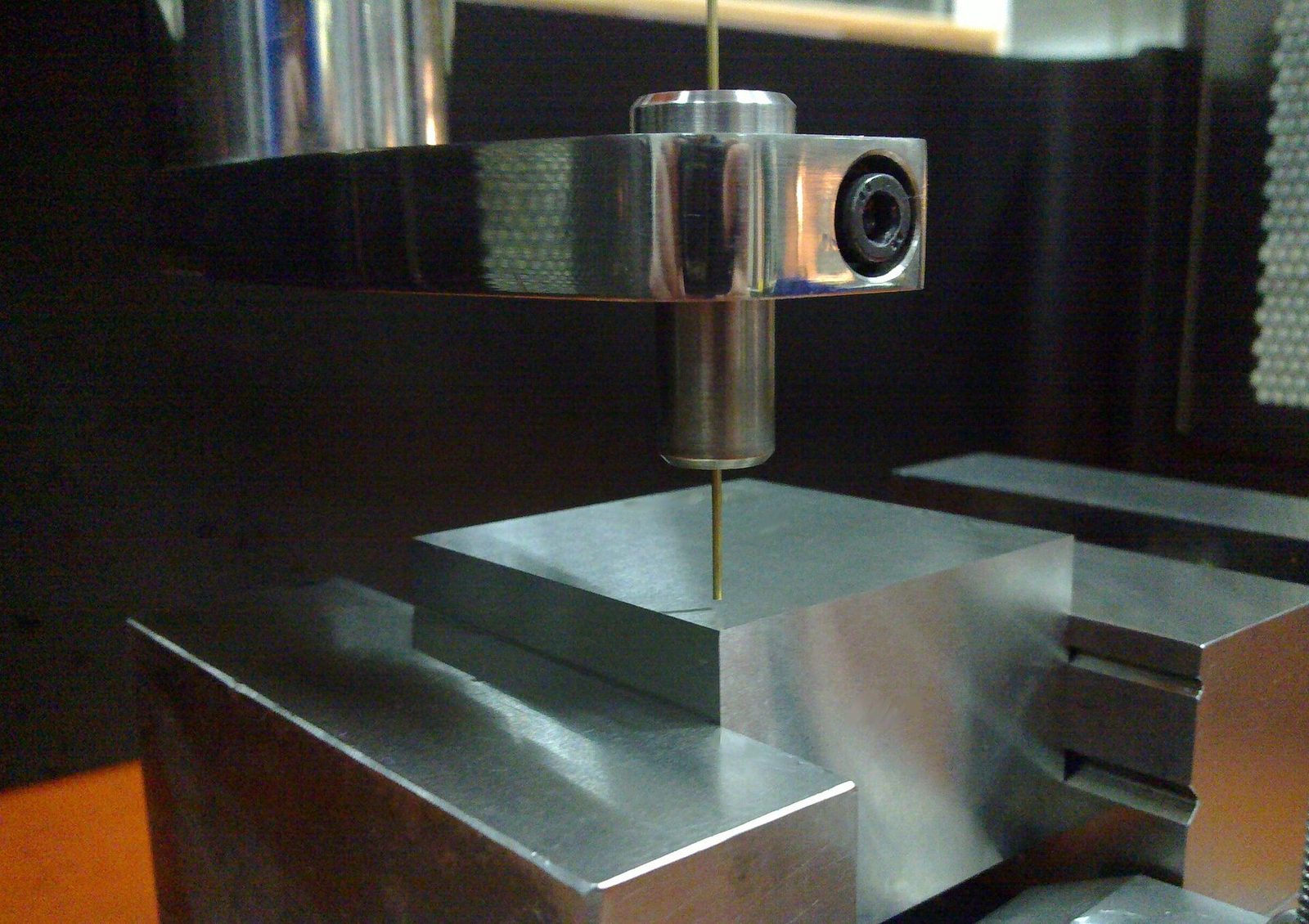
Wire EDM
A thin wire travels through the workpiece and cuts a precise profile, which makes wire EDM the standard choice for through-features: punch and die profiles, fine slots, keyways and sharp internal corners. Because the wire is a single diameter, internal corners can be far sharper than milling permits.
Wire EDM also cuts hardened material as easily as soft material, which means a die can be heat treated first and finished afterwards. That avoids the distortion risk of machining soft and hardening later.
Sinker (die-sinking) EDM
A shaped electrode burns a cavity into the workpiece, which is how hardened mould and die cavities with sharp internal detail are produced. Electrode wear is managed by using several electrodes in sequence, from roughing to finishing.
Because the electrode has to be manufactured first, sinker EDM carries tooling cost that wire EDM does not. That cost is why sinker EDM is usually reserved for cavities that cannot be milled - deep ribs, sharp internal detail and hardened material.
When EDM beats milling
Hardened material (milling becomes slow and expensive above roughly 45-50 HRC), internal corners sharper than the smallest available cutter radius, very fine slots, and deep narrow cavities where a milling tool would deflect or break.
The reverse also holds: for a large pocket in soft aluminium, EDM is dramatically slower than milling. The right answer is usually a combination - mill everything reachable, then EDM only the features the cutter cannot produce.
The heat-affected layer, and why finishing passes matter
The spark erodes material thermally, which leaves a recast layer on the cut surface. Roughing passes leave it thicker; successive finishing passes remove most of it and improve surface integrity as well as finish.
Where a part is fatigue-loaded - a die that will run for a million cycles, or a component in a vibrating assembly - the recast layer is a crack initiation site. Specifying the finishing passes rather than stopping at the roughing cut is what protects the part in service.
| Process | Cuts | Best for |
|---|---|---|
| Wire EDM | conductive materials | through-profiles, sharp corners, fine slots |
| Sinker EDM | conductive materials | hardened dies and moulds, deep cavities |
| Small-hole EDM | conductive materials | start holes, cooling channels |
Part families that need EDM
- Punch, die and trim tooling in hardened steel
- Mould inserts with sharp internal corners and deep ribs
- Fine slots, grids and screens in conductive material
- Start holes and cooling channels in hardened blocks
- Cutting tools and wear parts where corner radius is critical
What most often goes wrong with EDM work
Roughing leaves a recast layer. On a fatigue-loaded part that layer is where cracks start, so finishing passes are not cosmetic.
EDM is slower than milling by a wide margin. Paying for it on a feature a cutter can reach is the most common waste.
Wire EDM needs a threaded start hole. If the drawing has no place for one, the part may need a design change after it is already quoted.
Questions we get asked about wire & sinker edm
Can EDM machine any material?
Only conductive materials. Steels, aluminium, copper, brass, titanium and conductive carbides all work; plastics, ceramics and glass do not. For those, the route is usually laser, waterjet or grinding.
Is EDM slower than milling?
Substantially slower for bulk material removal, which is why EDM is normally used only for the features milling cannot reach. A typical part is milled first and then EDM finished.
How sharp can an internal corner be with wire EDM?
The internal corner radius is governed by the wire diameter plus the spark gap, so radii far below what any milling cutter achieves are routine. The practical limit depends on the wire selected and the flushing conditions.
Does EDM affect the material properties?
The spark leaves a thin recast layer that is harder and more brittle than the base material. Finishing passes remove most of it; where fatigue life matters, the depth of that layer and the finishing sequence should be specified.
- Sharp internal corners without cutter-radius limits
- Hardened material machined after heat treatment
- Fine slots and deep cavities
- Dimensional inspection after finishing
Quote an EDM feature
Send the drawing and mark the features that need EDM. We will confirm whether wire, sinker or a milled route is cheaper.